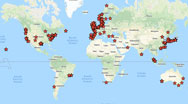
WAMIT® is the most advanced set of tools available for analyzing wave interactions with offshore platforms and other structures or vessels. Since the announcement of Version 1 in 1987 at MIT, WAMIT has gained widespread recognition for its ability to analyze complex structures with a high degree of accuracy and efficiency. Over the subsequent years WAMIT has been licensed to more than 200 industrial and research organizations worldwide. Upgrades have been issued at approximately two-year intervals, with many enhancements.
WAMIT Version 6, which was available from 2000-2011, represented a quantum jump in capabilities, including a higher-order method of solution and various options for defining the geometry. Version 6S has the additional capability of complete second-order nonlinear analysis in bichromatic and bidirectional waves. Subsequent updates included the option to link WAMIT with the Relational Geometry Kernel of the CAD program MultiSurf, facilitating a seamless transition from design to hydrodynamic analysis; to analyze internal tanks with free surfaces coupled with the dynamics of vessels; to evaluate the mean drift forces and moments on structures from the momentum flux through a control surface surrounding each structure; to trim waterlines, to automatically represent control surfaces and interior free surfaces, to input response-amplitude operators (RAO) from users' post-processors, and to use more flexible inputs for multi-body analysis. A complete chronological list of the updated features in Version 6 is in Chapter 1 of the V64 User Manual.
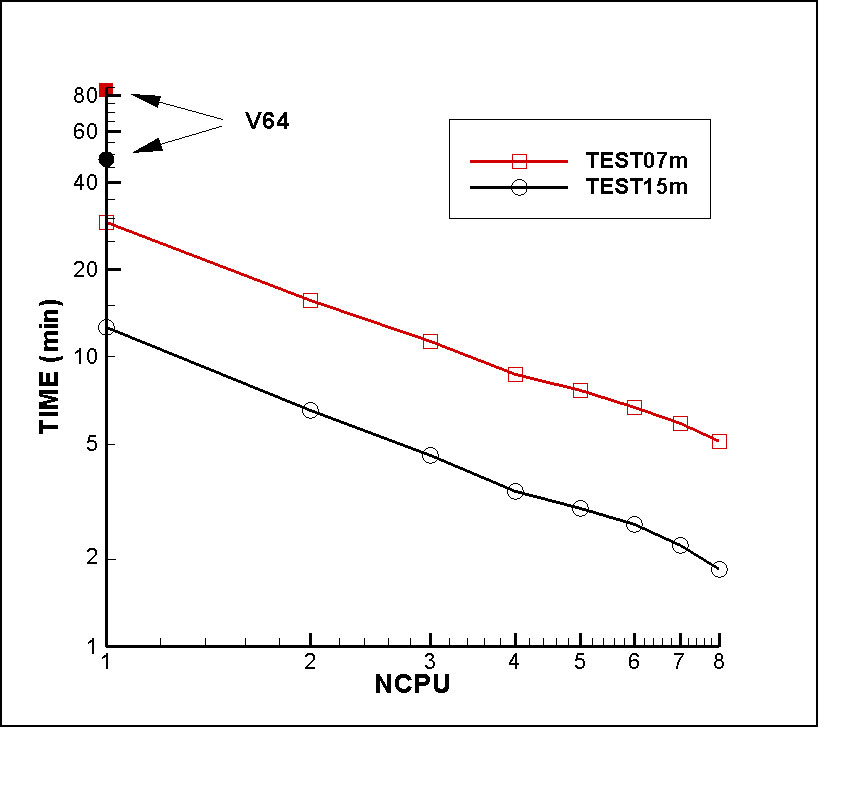
WAMIT Version 7 has additional extensions and updates from Version 6.4. The computations can be performed using parallel processing on PC's with multiple processors (CPU's), and the increased memory size of contemporary PC's can be exploited to achieve substantially faster run times for large complex applications. Further details are provided here, and in the V7 User Manual. Most of these options can be tested using the Demonstration Version of WAMIT®.
WAMIT Version 7 is available in two separate versions for Windows and Linux operating systems. Licensing Information